What is an M12 connector?
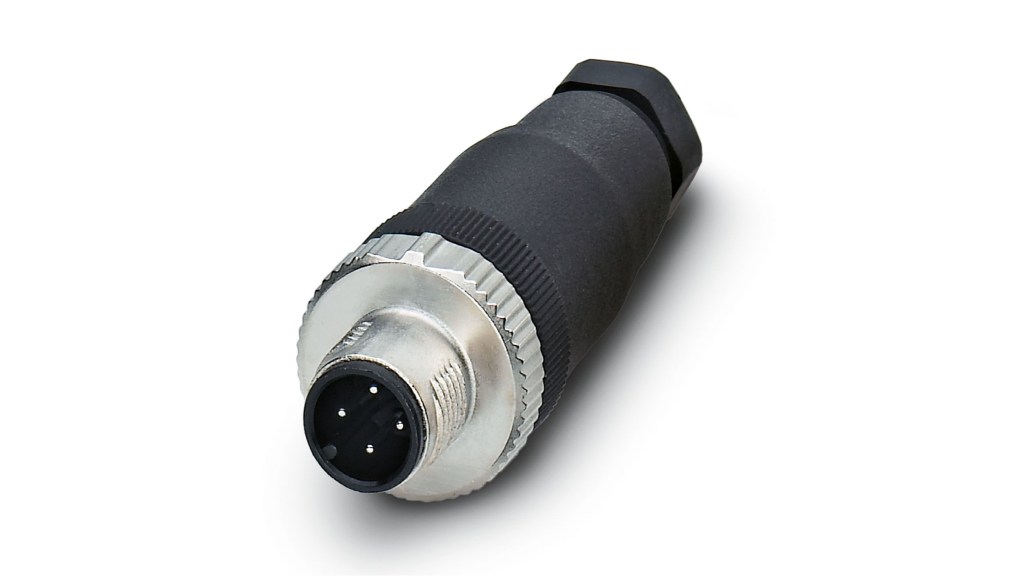
The M12 connector is a type of circular connector that is widely used in industrial applications, particularly in automation, sensor connections, and industrial Ethernet networks. M12 stands for “Metric”, and the number “12” denotes the diameter of the circular mating interface in millimeters. It might be essential to note that this thread is a metric fine thread (M12x1).
M12 connectors are known for their robust design, reliability, and versatility, making them suitable for harsh industrial environments.
Key features of M12 connectors
Circular Design: M12 connectors have a circular form factor, which facilitates easy and secure connections. The circular shape provides mechanical stability and ensures a consistent mating interface.
Threaded Coupling: M12 connectors typically use a threaded coupling mechanism. The connectors have screw threads that allow for a secure and vibration-resistant connection. This is particularly important in industrial settings where machinery vibrations and movements are common.
Variety of Configurations: M12 connectors come in various configurations, including different numbers of pins and keying options. Common configurations include 3-pin, 4-pin, 5-pin, and 8-pin variants. The number of pins in the connector determines the type of signals it can transmit, making M12 connectors suitable for power, signal, or Ethernet applications.
Coding Options (explained below in detail): M12 connectors often have coding options to prevent mis-mating and ensure that connectors of the same type are correctly matched. Different coding options include A-coded, B-coded, D-coded, and X-coded variants, each serving specific applications and protocols.
IP Ratings: M12 connectors are designed to provide environmental protection against dust and moisture. They often come with Ingress Protection (IP) ratings, indicating their resistance to environmental conditions. Common IP ratings for M12 connectors include IP67, which signifies protection against dust and temporary immersion in water.
Versatility: M12 connectors are versatile and find applications in various industries, including manufacturing, automotive, process control, and robotics. They are commonly used for connecting sensors, actuators, motors, and other devices in industrial automation systems.
Ethernet Connectivity: M12 connectors are widely employed in industrial Ethernet networks. The M12 connector with D-coded configuration is used for networks with a transmission speed up until 100Mbps while the one with X-coded configuration is designed to support high-speed data transmission, making it suitable for Gigabit Ethernet and other industrial communication protocols.
Resistance to Harsh Environments: M12 connectors are built to withstand harsh industrial environments, including temperature variations, vibrations, and exposure to chemicals. This robustness makes them suitable for use in demanding applications.
M12 coding types
M12 connector coding refers to the specific keying or polarization configurations used in M12 connectors to prevent mis-mating and ensure that connectors of the same type are correctly paired. This coding system is essential in industrial applications where multiple connectors are present, and accurate connections are critical for proper functionality. The coding helps in differentiating between connectors with varying functionalities, signal types, or voltage levels. Common M12 connector coding options include:

A-Coded (Standard):
Rated voltage 250VAC/DC (3-/4-pin), 60VAC/DC (5-pin) and max. 4A per contact.
A-coded M12 connectors represent a widely adopted standard configuration, particularly in sensor and actuator connections. These connectors are commonly utilized for digital, analog signal, and power applications.
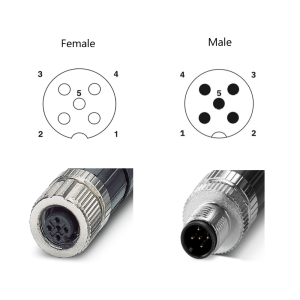
Removing certain contacts allows for a partial configuration of the 5-pin versions without altering the pin arrangement. Consequently, the 3-pin and 4-pin versions are compatible with a 5-pin version, maintaining port compatibility.
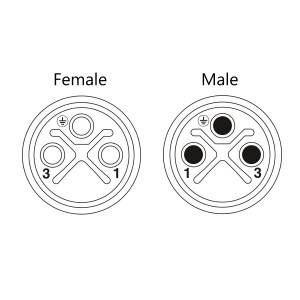
The image above displays both female and male pinouts. Naturally, it’s essential to note that when connecting a pair, one side must feature male pins (plug), while the other side must be female (socket). Also notice that the pin numbers are mirrored, ensuring correct alignment when facing each other. This is a common error when doing the wiring of M12 connectors.
When terminating an open-ended cable with a custom wired connector, it is crucial to match the correct wires to the corresponding pins based on the gender-specific pinout. Additionally, the image emphasizes a color-coding scheme: female gender pins are depicted in white, indicating a socket, while male gender pins are filled with black color, illustrating a pin.
B-coded:
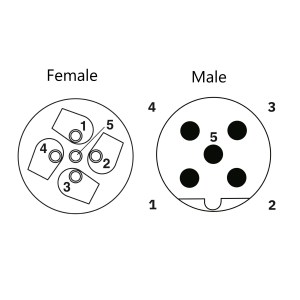
M12 5-pin, Profibus 2-pin used: rated voltage 60VAC/DC and max. 4A per contact.
B-coded M12 connectors are often used for industrial fieldbus systems such as Profibus and Interbus. Suitable for data communication and industrial networks.
C-coded:
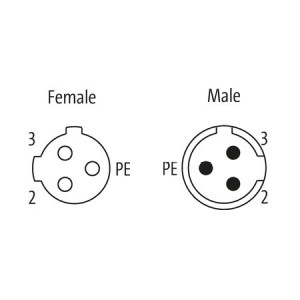
M12 C-coded 3-4 pin: rated voltage AC/DC 250V, rated current max. 4A per contact.
C-coded M12 connectors are designed for power applications. It is used for power transmission in industrial settings.
D-coded:
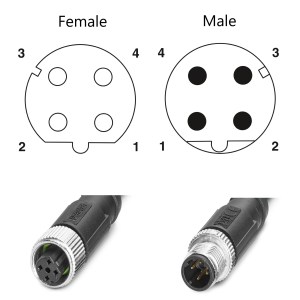
M12 4-pin: rated voltage 60VAC/DC and max. 4A per contact. Data transmission max. 100Mbps.
This is another widely used coding type. D-coded M12 connectors are commonly used at networking cables for industrial Ethernet applications such as Profinet, Ethernet/IP and EtherCAT.

X-coded:
M12 8-pin: rated voltage 50VAC/60VDC and max. 0.5A per contact. Data transmission up to 10Gbps.
X-coded M12 connectors are designed for high-speed data transmission in industrial Ethernet applications, including Gigabit Ethernet. It is suitable for demanding data communication requirements.

K-coded:
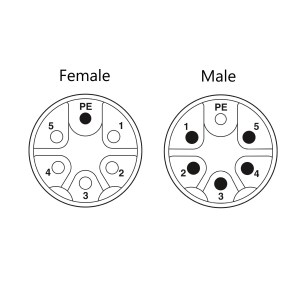
M12 5-pin: rated voltage 630VAC/DC and max. 12A per contact.
M12 K-coded connectors are designed for power connections.
L-coded:
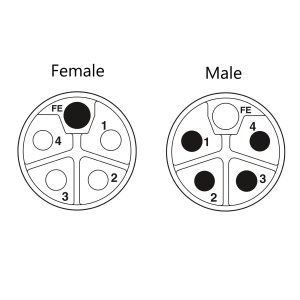
M12 5-pin (with/without functional earth): rated voltage 63VAC/DC and max. 16A per contact.
M12 L-coded connectors are designed for power connections.
M-coded:
M12 6-pin: rated voltage 630VAC and rated current max. 8A.
M12 M-coded connectors are designed for power connections.
S-coded:
M12 4-pin: rated voltage 630VAC/DC and max. 12A per contact.
M12 S-coded connectors are designed for power connections.

T-coded:
M12 4-pin: rated voltage 63VAC/DC and max. 12A per contact.
M12 T-coded connectors are designed for power connections.
Y-coded:
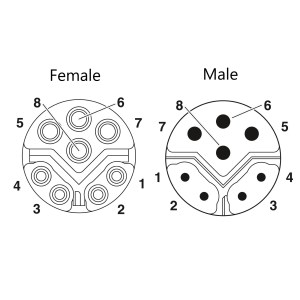
M12 8-pin: rated voltage 50 VAC/DC and max 0.5A per contact (signal)/6A (power). Data transmission up to 100Mbps.
M12 Y-coded connector is designed for hybrid connections, which can transmit both power and data in the same connection. Metal coding in the shape of a Y effectively separates data communication from power transmission.
Conclusion
The capability of M12 connectors to handle power, data, and signals positions it as a versatile and reliable choice. Due to its standardization, ongoing development, and alignment with market needs, they are widely used in the industrial automation.

 Industrial Machine Design & Automation
Leave a comment