

As we stand on the brink of technological revolution in industrial communication, the role of the IO Link protocol in shaping the future cannot be overstated. This powerful tool, standardized under IEC 61131-9, is fundamentally changing how data from sensors and actuators are communicated to control systems, making it an indispensable part of modern industrial setups. The introduction of the IO Link protocol has marked a significant leap forward, ensuring efficiency, flexibility, and simplicity in acquiring and managing sensor data. This progress is not just about enhancing operational efficiency but is pivotal in driving the smart factory vision into reality, where every component, however small, is interconnected and intelligent.
This article delves into the essence of IO Link communication protocol, outlining its benefits, system components, configuration, and the diverse applications where it is making a difference. We will explore what sets the IO Link protocol apart in the realm of industrial communication, including an explanation on the difference between IO Link class A and class B, thus offering a comprehensive guide to understanding this transformative technology. From increasing industrial automation capabilities to streamlining the integration of smart devices, the IO Link system is indeed leading the way towards a more connected and efficient industrial future.
Understanding IO-Link Communication Technology
Definition and Basics

IO-Link is a robust, serial, bi-directional point-to-point connection for signal transmission and power supply, compatible with any network, fieldbus, or backplane bus. It is recognized as the first I/O technology for communicating with sensors and actuators to be adopted as an international standard, as specified in IEC 61131-9. This technology facilitates both the cyclic exchange of digital input and output process data and the acyclic exchange of parameter and diagnostic data between a master and its associated devices. The master device, essential for this communication, can connect to higher-level systems such as a fieldbus, industrial Ethernet, or directly to MES, ERP, or cloud-based systems, enhancing its versatility and integration capabilities.
Historical Background
IO-Link’s development was motivated by the need for a standardized, efficient way to communicate with sensors and actuators. It was officially standardized as part of IEC 61131-9, making it the first globally recognized standard for such communication. This standardization has played a crucial role in its adoption across various industrial sectors, providing a consistent, reliable means of data transmission and device control.
Global Adoption and Standardization
The global adoption of IO-Link technology is evident from its integration into various regional markets, with North America leading in its implementation. The technology’s ability to support all fieldbus protocols and its integration into compact machines enhance its market appeal and growth potential. The IO-Link market is projected to reach USD 33.9 billion by 2028, growing at a CAGR of 20.0% from 2023 to 2028, which underscores its increasing significance and the broadening scope of its applications.
IO-Link’s universal application is further supported by its compatibility with standard unshielded 3-wire cables used for conventional discrete I/O, which simplifies installation and reduces costs. This ease of use, combined with the technology’s robust communication capabilities, makes IO-Link a pivotal element in the advancement of industrial communication and automation.
Key Benefits of IO-Link Technology
Real-time Data Access and Machine Optimization
IO-Link technology enables comprehensive access to all field data, significantly enhancing the integration of sensor and actuator intelligence into automation systems. This integration facilitates the derivation of machine optimizations, leading to increased operational efficiency. By leveraging real-time data from the field level, predictive maintenance can be effectively planned, thus enhancing the availability and reliability of systems.
Enhanced Plant Availability
The continuous monitoring of devices through IO-Link allows for early detection of irregularities, which plays a crucial role in proactive maintenance and operational continuity. This technology enables the monitoring of diagnostic data without the need for physical access, thus simplifying maintenance procedures and reducing downtime. The use of a standardized M12 plug for both power supply and data transmission streamlines the process, ensuring that plant availability is maximized.
Support for New Business Models
The transparency of data from the sensor-actuator level to the automation level provided by IO-Link opens up new business opportunities. This visibility allows businesses to stay ahead of the competition by identifying and capitalizing on new market trends and demands. The flexibility offered by IO-Link, being a free standard, allows the use of products from various manufacturers, fostering innovation and adaptability in developing new business models.
IO-Link System Components and Configuration
Overview of System Components

An IO-Link system comprises several fundamental components that ensure seamless integration and communication within industrial settings. The core components include the IO-Link master, IO-Link devices such as sensors, RFID readers, and actuators, and standard unshielded cables which facilitate connection and communication. The IO-Link master plays a pivotal role, acting as the intermediary between IO-Link devices and the automation system. It can be installed directly in the field or within a control cabinet, and it communicates over various fieldbuses or specific backplane buses.
Setting Up an IO-Link System
The configuration of an IO-Link system begins with the integration of the IO-Link master into the automation system, followed by connecting the IO-Link devices to the master’s ports. This setup allows for point-to-point communication, which is crucial for precise device control and data transmission. The system’s parameters are configured using an engineering tool, which assigns and manages device parameters through a user-friendly interface. This tool displays all connected IO-Link masters and devices, facilitating easy management and configuration.
Integration with Automation Systems
Integrating an IO-Link system with existing automation systems enhances operational efficiency and device interoperability. The IO-Link master is represented within the automation system or fieldbus configuration, utilizing appropriate device descriptions to ensure compatibility and optimal performance. This integration allows the IO-Link system to be meshed with the overall engineering of the automation system, making it an integral part of the industrial control environment.
Explanation of IO-Link Class A and Class B

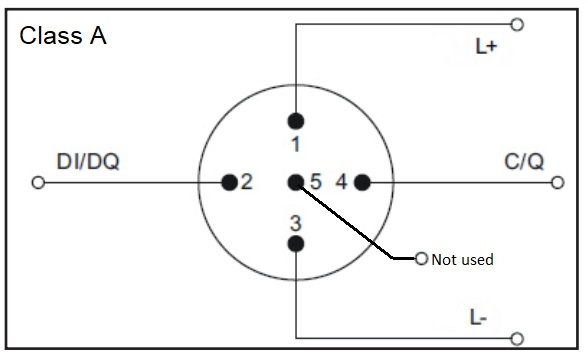
IO-Link utilizes two types of port classes to accommodate different device requirements. Port Class A is typically used for sensors and employs a standard three-core cable for power and data transmission, providing up to 200 mA of current. In contrast, Port Class B is designed for actuators requiring higher power and uses a five-core cable. This class includes additional conductors for actuator power supply and a separate galvanically isolated reference potential, ensuring reliable operation of power-intensive devices.
Pin assignments of Class A and Class B:

Applications and Use Cases
Industry-specific Applications
IO-Link technology has been instrumental in enhancing operations across various industries through its innovative applications. In the realm of assembly automation, machine tools, and intralogistics, IO-Link plays a crucial role in status communication and machine control. For instance, in the machine-tool industry, IO-Link-enabled pressure sensors are utilized to verify workpiece clamping, significantly reducing the number of rejected workpieces. Additionally, position sensors on assembly machines ensure proper alignment, aiding in maintenance by reporting status, which allows for predictive maintenance and operational improvements.
The pharmaceutical packaging sector benefits from IO-Link by enabling process validation down to the lowest automation level, thus ensuring compliance and precision in highly regulated environments. Similarly, intralogistics utilize IO-Link for achieving the greatest flexibility in overhead conveyors, adapting swiftly to varying operational demands.
Comparative Advantages over Traditional Systems
IO-Link offers several advantages over traditional analog systems, particularly in terms of installation and maintenance. The technology facilitates easy plug-and-play installation, which not only reduces initial setup time but also minimizes errors typically associated with manual configurations. Moreover, IO-Link’s capability for remote parameterization and monitoring allows for real-time adaptability and minimal downtime, eliminating the need for manual intervention or machine shutdowns to adjust sensor parameters.
Comparatively, traditional systems often require extensive manual configuration and physical adjustments, which can lead to increased downtime and higher maintenance costs. IO-Link’s streamlined approach not only enhances operational efficiency but also reduces overall maintenance costs.
Future Trends and Developments
The future of IO-Link looks promising with its integration into the evolving landscape of industrial automation. As industries continue to adopt Industry 4.0 and smart manufacturing technologies, the demand for IO-Link is expected to surge. This growth is driven by the technology’s support for predictive maintenance and condition monitoring, essential components in modern manufacturing environments.
Moreover, the development of IO-Link master devices with enhanced features and functionalities is anticipated to open new avenues for innovation. These advancements are likely to further integrate IO-Link into more complex systems, expanding its applications and reinforcing its position as a cornerstone technology in industrial communication and automation.
Conclusion
The exploration of IO-Link protocol in this article underscores its critical role in the advancement of industrial communication, highlighting how it enhances operational efficiency, flexibility, and system integration. By providing a deep dive into the protocol’s functionality, benefits, and diverse applications, we’ve seen its potential to transform traditional industrial settings into smart, interconnected systems. The contrasts drawn between IO-Link Class A and Class B devices illuminate the protocol’s versatility in catering to various power and communication needs across a wide spectrum of industrial devices, embodying its core strength in facilitating precision and reliability in data transmission and device control.
As industries march towards adopting smarter manufacturing practices, the significance of IO-Link in this transition cannot be overstated. Its ability to offer real-time data access, machine optimization, and enhanced plant availability positions it as a cornerstone technology in realizing the vision of Industry 4.0. The discussion on its growing global adoption and projected market expansion further emphasizes the protocol’s emerging role as a standard in industrial automation. Ultimately, IO-Link stands out as a pivotal element in the evolving landscape of industrial communication, promising to drive innovation, efficiency, and sustainability in manufacturing processes worldwide. As we move forward, the importance of continued exploration and adoption of such technologies will be paramount in harnessing the full potential of industrial automation.
FAQs
1. What makes IO-Link so widely used in industry?
IO-Link is highly popular due to its significant benefits for machine builders and discrete manufacturers. Machine builders, in particular, find that the simplified wiring scheme of IO-Link devices can reduce their wiring hardware and labor costs by 30%-60% for sensors, outputs, and controls.
2. What are the main advantages of using IO-Link in industrial settings?
IO-Link enhances operational efficiency by optimizing the timing of machine processes. It eliminates signal delays and distortions, ensuring high signal quality through its digital data transmission capabilities.
3. What type of industrial protocol is IO-Link classified as?
IO-Link is a point-to-point network communications standard and protocol specifically designed for sensors and actuators. It is recognized as an IEC standard under IEC 61131-9, offering numerous benefits over traditional hardwired I/O systems.
4. How does IO-Link communication function within industrial frameworks?
IO-Link serves as a cornerstone technology for Industry 4.0. It operates through digital communication that transmits raw sensor values directly, providing more precise data from machines and eliminating the inaccuracies associated with scaling analog signals.
References and Further Reading
https://www.ifm.com/us/en/shared/technologies/io-link/io-link-introduction
https://www.murrinc.com/us/products-industries/product-news/detail/news/io-link-ports-and-data/
https://www.murrinc.com/us/products-industries/product-news/detail/news/what-is-io-link/
https://en.wikipedia.org/wiki/IO-Link
https://io-link.com/en/Technology/what_is_IO-Link.php
Technology
https://www.bannerengineering.com/us/en/company/banner-blog/the-8-advantages-of-io-link.html
https://www.ifm.com/us/en/shared/technologies/io-link/benefits/benefits
https://www.stego-group.com/stego-blog/io-link-intelligent-automation-of-industrial-systems
https://www.siemens.com/global/en/products/automation/industrial-communication/io-link.html
Click to access IO-Link_System_Description_eng_2018.pdf
https://www.ifm.com/us/en/shared/technologies/io-link/support-tools/basic-setup
Click to access IO-Link_Design_Guideline_eng_2018.pdf
https://www.pepperl-fuchs.com/usa/en/io-link.htm
https://www.digikey.com/en/articles/making-use-of-io-link-in-industrial-applications
https://io-link.com/en/Technology/Applications.php
https://www.linkedin.com/pulse/application-io-link-industry-rex-wei
https://www.bannerengineering.com/us/en/company/banner-blog/the-8-advantages-of-io-link.html
https://www.ifm.com/us/en/shared/technologies/io-link/benefits/benefits
https://www.linkedin.com/pulse/io-link-market-2024-2032-future-trends-industry-luxjf/
https://www.linkedin.com/pulse/io-link-market-size-outlook-shaping-future-trends-lonrf/
https://www.digikey.com/en/articles/making-use-of-io-link-in-industrial-applications
Learn All About IO-Link – the Basics
 Industrial Machine Design & Automation
Leave a comment